

What Happens When You Machine Wash Dry Clean Only
Dry out cleaning is any cleaning process for clothing and textiles using a solvent other than water.
Dry cleaning still involves liquid, merely dress are instead soaked in a h2o-free liquid solvent, tetrachloroethylene (perchloroethylene), known in the industry as "perc", which is the most widely used solvent. Alternative solvents are 1-bromopropane and petroleum spirits.[1]
Virtually natural fibers can be washed in water but some synthetics (east.chiliad., viscose, lyocell, modal, and cupro) react poorly with water and must be dry out-cleaned.[2]
History [edit]
Dry cleaning originated[3] with American entrepreneur Thomas L. Jennings. Jennings referred to his method as "dry scouring".
French dye-works operator Jean Baptiste Jolly[four] [a] adult his ain method using kerosene and gasoline to clean fabrics.[4] He opened the first dry-cleaners in Paris in 1845.[half dozen]
Flammability concerns led William Joseph Stoddard, a dry cleaner from Atlanta, to develop Stoddard solvent (white spirit) equally a slightly less combustible alternative to gasoline-based solvents. The use of highly flammable petroleum solvents caused many fires and explosions, resulting in authorities regulation of dry cleaners. After Earth War I, dry cleaners began using chlorinated solvents. These solvents were much less flammable than petroleum solvents and had improved cleaning power.[ citation needed ]
Shift to tetrachloroethylene [edit]
By the mid-1930s, the dry cleaning industry had adopted tetrachloroethylene (perchloroethylene), or PCE for short, every bit the solvent. It has first-class cleaning power and is nonflammable and compatible with most garments. Because it is stable, tetrachloroethylene is readily recycled.[1]
Infrastructure [edit]
Dry cleaning businesses, from the perspective of the client, are either plants or drop shops. A constitute does on-site cleaning. A driblet shop receives garments from customers, sends them to a large plant, and and then has the cleaned garment returned to the shop for collection by the customer. The turnaround time is longer for a drop shop than for a local plant. However, running a plant requires more than work for the business owner. Since 2022, in some markets, web apps have been used to schedule low-toll home delivery for dry cleaning.[7]
This bike minimized the adventure of burn down or dangerous fumes created by the cleaning procedure. At this time, dry cleaning was carried out in two different machines—ane for the cleaning process, and the second to remove the solvent from the garments.
Machines of this era were described equally vented; their drying exhausts were expelled to the atmosphere, the same as many modern tumble-dryer exhausts. This not only contributed to environmental contagion but likewise much potentially reusable PCE was lost to the atmosphere. Much stricter controls on solvent emissions have ensured that all dry cleaning machines in the Western world are now fully enclosed, and no solvent fumes are vented to the temper.[ citation needed ] In enclosed machines, solvent recovered during the drying process is returned condensed and distilled, so it can be reused to clean further loads or safely tending of. The majority of modern enclosed machines also incorporate a estimator-controlled drying sensor, which automatically senses when all detectable traces of PCE have been removed. This organisation ensures that only small amounts of PCE fumes are released at the end of the cycle.
Mechanism [edit]
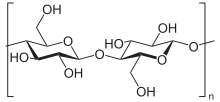
Construction of cellulose, the principal constituent of cotton. The many OH groups bind water, leading to swelling of the fabric and leading to wrinkling, which is minimized when these materials are treated with tetrachloroethylene and other dry cleaning solvents.
In terms of mechanism, dry out cleaning selectively solubilizes stains on the article. The solvents are non-polar and tend to selectively extract compounds that cause stains. These stains would otherwise only deliquesce in aqueous detergents mixtures at high temperatures, potentially damaging delicate fabrics.
Non-polar solvents are also practiced for some fabrics, especially natural fabrics, as the solvent does not interact with any polar groups within the fabric. H2o binds to these polar groups which results in the swelling and stretching of proteins inside fibers during laundering. Also, the binding of water molecules interferes with weak attractions within the fiber, resulting in the loss of the fiber's original shape. After the laundry cycle, h2o molecules will dry off. Nevertheless, the original shape of the fibers has already been distorted and this commonly results in shrinkage. Non-polar solvents forestall this interaction, protecting more than fragile fabrics.
The usage of an effective solvent coupled with mechanical friction from tumbling finer removes stains.
Process [edit]

A modern dry out cleaning automobile with touchscreen and SPS control. Manufacturer: EazyClean, type EC124. Photo taken prior to installation.

Series 3 dry out cleaning machine with PLC control. Manufacturer: BÖWE Textile Cleaning; Germany
A dry cleaning machine is similar to a combination of a domestic washing machine and clothes dryer. Garments are placed in the washing or extraction chamber (referred to as the 'basket' or 'pulsate'), which constitutes the core of the motorcar. The washing chamber contains a horizontal, perforated drum that rotates within an outer shell. The crush holds the solvent while the rotating drum holds the garment load. The basket capacity is between about 10 and 40 kg (22 to 88 lb).[ commendation needed ]
During the wash bicycle, the sleeping room is filled approximately i-third full of solvent and begins to rotate, agitating the clothing. The solvent temperature is maintained at 30 degrees Celsius (86 degrees Fahrenheit) or lower, as a higher temperature may damage information technology. During the wash cycle, the solvent in the sleeping accommodation (unremarkably known as the 'cage' or 'tackle box') is passed through a filtration chamber and and then fed back into the 'cage'. This is known as the cycle and is continued for the launder duration. The solvent is then removed and sent to a distillation unit consisting of a banality and condenser. The condensed solvent is fed into a separator unit where any remaining water is separated from the solvent and then fed into the clean solvent tank. The ideal period rate is roughly 8 liters of solvent per kilogram of garments per minute, depending on the size of the machine.
Garments are also checked for foreign objects. Items such as plastic pens may deliquesce in the solvent bathroom, damaging the textiles. Some material dyes are "loose" and will shed dye during solvent immersion. Fragile items, such as plumage bedspreads or tasseled rugs or hangings, may be enclosed in a loose mesh handbag. The density of perchloroethylene is around 1.7 g/cm3 at room temperature (seventy% heavier than water), and the sheer weight of absorbed solvent may cause the textile to fail under normal force during the extraction cycle unless the mesh bag provides mechanical back up.
Not all stains can be removed past dry cleaning. Some need to exist treated with spotting solvents — sometimes past steam jet or by soaking in special stain-remover liquids — before garments are washed or dry cleaned. Besides, garments stored in soiled status for a long time are hard to bring dorsum to their original color and texture.
A typical wash cycle lasts for 8–15 minutes depending on the type of garments and degree of soiling. During the first three minutes, solvent-soluble soils dissolve into the perchloroethylene and loose, insoluble soil comes off. It takes ten–12 minutes afterwards the loose soil has come off to remove the footing-in insoluble soil from garments. Machines using hydrocarbon solvents require a wash bike of at least 25 minutes because of the much slower rate of solvation of solvent-soluble soils. A dry cleaning surfactant "soap" may also be added.
At the end of the wash bike, the car starts a rinse bicycle where the garment load is rinsed with freshly distilled solvent dispensed from the solvent tank. This pure solvent rinse prevents discoloration caused by soil particles being captivated back onto the garment surface from the 'muddy' working solvent.
After the rinse bike, the automobile begins the extraction process, which recovers the solvent for reuse. Modern machines recover approximately 99.99% of the solvent employed. The extraction cycle begins by draining the solvent from the washing chamber and accelerating the basket to 350–450 rpm, causing much of the solvent to spin free of the fabric. Until this time, the cleaning is done in normal temperature, equally the solvent is never heated in dry cleaning process. When no more solvent tin can be spun out, the machine starts the drying cycle.
During the drying cycle, the garments are tumbled in a stream of warm air (sixty–63 °C/140–145 °F) that circulates through the basket, evaporating traces of solvent left later the spin cycle. The air temperature is controlled to prevent estrus harm to the garments. The wearied warm air from the motorcar then passes through a chiller unit where solvent vapors are condensed and returned to the distilled solvent tank. Modern dry cleaning machines utilize a airtight-loop arrangement in which the chilled air is reheated and recirculated. This results in loftier solvent recovery rates and reduced air pollution. In the early days of dry cleaning, big amounts of perchloroethylene were vented to the atmosphere because information technology was regarded as cheap and believed to be harmless.

Many dry cleaners identify cleaned clothes inside sparse clear plastic garment numberless
After the drying cycle is consummate, a deodorizing (aeration) cycle cools the garments and removes further traces of solvent by circulating cool outside air over the garments then through a vapor recovery filter made from activated carbon and polymer resins. Afterward the aeration bicycle, the garments are clean and ready for pressing and finishing.
Solvent processing [edit]
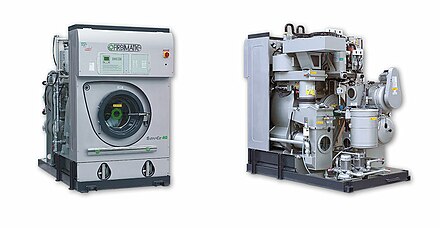
A Firbimatic Saver Series. This machine uses activated clay filtration instead of distillation. It uses much less energy than conventional methods.
Working solvent from the washing bedchamber passes through several filtration steps before information technology is returned to the washing bedroom. The commencement step is a button trap, which prevents small objects such as lint, fasteners, buttons, and coins from entering the solvent pump.
Over time, a thin layer of filter cake (called "muck") accumulates on the lint filter. The muck is removed regularly (commonly once per mean solar day) and and so processed to recover solvent trapped in the muck. Many machines use "spin disk filters", which remove the muck from the filter past centrifugal strength while information technology is back washed with solvent.
Afterwards the lint filter, the solvent passes through an absorbent cartridge filter. This filter, which contains activated clays and charcoal, removes fine insoluble soil and not-volatile residues, forth with dyes from the solvent. Finally, the solvent passes through a polishing filter, which removes any soil not previously removed. The clean solvent is and so returned to the working solvent tank. Cooked powder residuum is the name for the waste product generated by cooking down or distilling muck. It will comprise solvent, powdered filter material (diatomite), carbon, not-volatile residues, lint, dyes, grease, soils, and water. The waste sludge or solid residue from the however contains solvent, water, soils, carbon, and other not-volatile residues. Used filters are some other form of waste as is waste product water.
To heighten cleaning power, small amounts of detergent (0.five–one.v%) are added to the working solvent and are essential to its functionality. These detergents emulsify hydrophobic soils and keep soil from redepositing on garments. Depending on the motorcar'south design, either an anionic or a cationic detergent is used.
Symbols [edit]
The international GINETEX laundry symbol for dry cleaning is a circle. Information technology may accept the letter P within it to betoken perchloroethylene solvent, or the alphabetic character F to point a flammable solvent (Feuergefährliches Schwerbenzin). A bar underneath the circle indicates that only mild cleaning processes is recommended. A crossed-out empty circle indicates that an item should not be dry out cleaned.[8]
-

Professional person cleaning symbol
-

Dry clean, hydrocarbon solvent only (HCS)
-

Gentle cleaning with hydrocarbon solvents
-

Very gentle cleaning with hydrocarbon solvents
-

Gentle cleaning with PCE
-

Very gentle cleaning with PCE
-

Practice not dry clean
Solvents used [edit]
Perchloroethylene [edit]

Perchloroethylene (PCE, or tetrachloroethylene) has been in use since the 1930s. PCE is the most common solvent, the "standard" for cleaning functioning. It is a highly effective cleaning solvent. It is thermally stable, recyclable, and has low toxicity. It can, however, cause color bleeding/loss, especially at higher temperatures. In some cases it may damage special trims, buttons, and chaplet on some garments. Information technology is better for oil-based stains (which account for about 10% of stains) than more common h2o-soluble stains (coffee, vino, blood, etc.). The toxicity of tetrachloroethylene "is moderate to depression" and "Reports of homo injury are uncommon despite its broad usage in dry cleaning and degreasing".[9]
Hydrocarbons [edit]
Hydrocarbons are represented by products such every bit Exxon-Mobil's DF-2000 or Chevron Phillips' EcoSolv, and Pure Dry out. These petroleum-based solvents are less ambitious just also less effective than PCE. Although combustible, risk of fire or explosion can be minimized when used properly. Hydrocarbons are withal pollutants. Hydrocarbons retain well-nigh 10-12% of the market.

A modern dry cleaning car for utilize with various solvents
Trichloroethylene [edit]
Trichloroethylene is more aggressive than PCE but is very rarely used. With superior degreasing properties, it was often used for industrial workwear/overalls cleaning in the by. TCE is classified equally carcinogenic to humans by the United States Ecology Protection Agency.[x]
Supercritical COtwo [edit]
Supercritical CO2 is an alternative to PCE; however, it is inferior in removing some forms of grime.[11] Additive surfactants improve the efficacy of COii. [12] Carbon dioxide is about entirely nontoxic. The greenhouse gas potential is as well lower than that of many organic solvents.
The dry out cleaning process involves charging a sealed chamber which is loaded with clothes using gaseous carbon dioxide from a storage vessel to approximately 200 to 300 psi. This stride in the procedure is initiated every bit a precaution to avoid thermal shock to the cleaning chamber. Liquid carbon dioxide is so pumped into the cleaning sleeping room from a separate storage vessel by a hydraulic, or electrically driven pump (which preferably has dual pistons). The pump increases the force per unit area of the liquid carbon dioxide to approximately 900 to 1500 psi. A separate sub-cooler reduces the temperature of the carbon dioxide by 2 to 3 degrees Celsius below the boiling point in an effort to forbid cavitation which could lead to premature degradation of the pump. [13]
Consumer Reports rated supercritical CO2 superior to conventional methods, but the Drycleaning and Laundry Institute commented on its "adequately low cleaning ability" in a 2007 report.[14] Supercritical COii is, overall, a mild solvent which lowers its ability to aggressively assault stains.
One deficiency with supercritical CO2 is that its electrical conductivity is low. As mentioned in the Mechanisms department, dry out cleaning utilizes both chemical and mechanical properties to remove stains. When solvent interacts with the fabric's surface, the friction dislocates dirt. At the same time, the friction too builds up an electrical accuse. Fabrics are very poor conductors and so usually, this build-upwards is discharged through the solvent. This discharge does not occur in liquid carbon dioxide and the build-up of an electrical charge on the surface of the fabric attracts the dirt back on to the surface, which diminishes its cleaning efficiency. To compensate for the poor solubility and conductivity of supercritical carbon dioxide, enquiry has focused on additives. For increased solubility, 2-propanol has shown increased cleaning effects for liquid carbon dioxide every bit it increases the power of the solvent to dissolve polar compounds.[15]
Machinery for utilise of supercritical CO2 is expensive—up to $90,000 more than a PCE machine, making affordability hard for small businesses. Some cleaners with these machines go on traditional machines on-site for more heavily soiled textiles, just others notice institute enzymes to be equally effective and more environmentally sustainable.
Other solvents: niche, emerging, etc. [edit]
For decades, efforts have been made to replace PCE. These alternatives accept non proven economical thus far:
- Stoddard solvent – combustible and explosive, 100 °F/38 °C flash point
- CFC-113 (Freon-113), a Chlorofluorocarbon. At present banned as ozone-unfriendly.
- Decamethylcyclopentasiloxane ("liquid silicone"), called D5 for short. It was popularized by GreenEarth Cleaning.[16] It is more expensive than PCE. It degrades within days in the environment.
- Dibutoxymethane (SolvonK4) is a bipolar solvent that removes h2o-based stains and oil-based stains.[17]
- Brominated solvents (n-propyl bromide, Fabrisolv, DrySolv) are solvents with higher KB-values than PCE. This allows faster cleaning, but can impairment some synthetic beads and sequins if not used correctly. Healthwise, in that location are reported risks associated with nPB such every bit numbness of nerves.[xviii] The exposure to the solvents in a typical dry out cleaner is considered far below the levels required to cause whatever risk.[19] Environmentally, information technology is canonical by the U.S. EPA. It is amid the more expensive solvents, but it is faster cleaning, lower temperatures, and quick dry times.
Encounter also [edit]
- Fabric restoration
- Listing of laundry topics
- Wet cleaning
Notes [edit]
- ^ In some sources incorrectly[five] referred to as "Jolly-Belin"
References [edit]
- ^ a b David C. Tirsell "Dry Cleaning" in Ullmann's Encyclopedia of Industrial Chemical science, Wiley-VCH, Weinheim, 2000. doi:10.1002/14356007.a09_049
- ^ Hunter, Jennifer (22 May 2022). "Dry Cleaning Your Wool Sweaters? Don't Bother". The New York Times . Retrieved xxx May 2022.
- ^ Johnson, Shontavia. "America's always had blackness inventors – even when the patent system explicitly excluded them". The Conversation . Retrieved 2021-06-19 .
- ^ a b Oladele Ogunseitan (iii May 2022). Dark-green Health: An A-to-Z Guide. SAGE Publications. pp. 135–. ISBN978-1-4522-6621-3.
- ^ Ancliffe Prince (1965). Laundering and Cleaning: Yesterday, To-day, and To-morrow. Iliffe Technical Publications.
In Britain America the discovery was for long attributed to a supposed Paris tailor past name of Jolly-Belin [...] Actually the discoverer of drycleaning was not named Jolly-Belin just Jean-Baptiste Clot
- ^ Reed Business Information (13 Feb 1986). New Scientist. Reed Business organization Information. pp. 33–. ISSN 0262-4079.
- ^ Lee, Sunny (1 October 2022). "The uncertain future of your neighborhood dry out cleaner". The Outline . Retrieved 2019-10-11 .
- ^ "Professional person cloth intendance symbols". GINETEX - Swiss Association for Textile Labelling. Archived from the original on 2022-05-28. Retrieved 2013-07-18 .
- ^ E.-L. Dreher; T. R. Torkelson; Thou. K. Beutel (2011). "Chlorethanes and Chloroethylenes". Ullmann'due south Encyclopedia of Industrial Chemistry. Weinheim: Wiley-VCH. doi:10.1002/14356007.o06_o01. ISBN978-3527306732.
- ^ EPA Releases Final Health Cess for TCE [ane] September 2022. Accessed 2022-09-28.
- ^ "Dry-cleaning with CO2 wins award [Scientific discipline] Resource". Resources.wur.nl. 2022-10-12. Archived from the original on 2022-03-12. Retrieved 2013-03-14 .
- ^ "How can we utilise carbon dioxide as a solvent?". Contemporary topics in schoolhouse science. Retrieved 2016-08-29 .
- ^ "Liquid/supercritical carbon dioxide/dry out cleaning system". 1993-12-06. Retrieved 2021-01-02 .
- ^ Drycleaning and Laundry Institute. "The DLI White Paper: Key Information on Industry Solvents." The Western Cleaner & Launderer, August 2007.
- ^ US 5784905, Townsend, Carl W.; Chao, Sidney C. & Purer, Edna 1000., "Liquid carbon dioxide cleaning organisation employing a static dissipating fluid", published 1998-07-28
- ^ Tarantola, Andrew. "There's a Better Mode to Dry out Clean Your Dress". Gizmodo . Retrieved 2016-08-29 .
- ^ Ceballos, Diana M.; Whittaker, Stephen Yard.; Lee, Eun Gyung; Roberts, Jennifer; Streicher, Robert; Nourian, Fariba; Gong, Wei; Broadwater, Kendra (2016). "Occupational exposures to new dry cleaning solvents: High-flashpoint hydrocarbons and butylal". Journal of Occupational and Environmental Hygiene. 13 (ten): 759–769. doi:10.1080/15459624.2016.1177648. PMC5511734. PMID 27105306.
{{cite periodical}}: CS1 maint: uses authors parameter (link) - ^ "Gamble EVALUATION ane-Bromopropane" Archived 2022-11-06 at the Wayback Machine July 2003. Accessed 2022-Jan-22
- ^ Azimi Pirsaraei, S. R.; Khavanin, A; Asilian, H; Soleimanian, A (2009). "Occupational exposure to perchloroethylene in dry-cleaning shops in Tehran, Islamic republic of iran". Industrial Health. 47 (2): 155–9. doi:10.2486/indhealth.47.155. PMID 19367044.
External links [edit]
- Hazard Summary provided by the United states Environmental Protection Agency.
- NIOSH Prophylactic and Health Topic: Drycleaning

Source: https://en.wikipedia.org/wiki/Dry_cleaning
Posted by: dummerobeguistake.blogspot.com
0 Response to "What Happens When You Machine Wash Dry Clean Only"
Post a Comment