

How To Clean Condenser Coils On Whirlpool Side By Sides
How to Avoid Refrigerator Repairs
These half-dozen maintenance steps will prevent most refrigerator breakdowns.
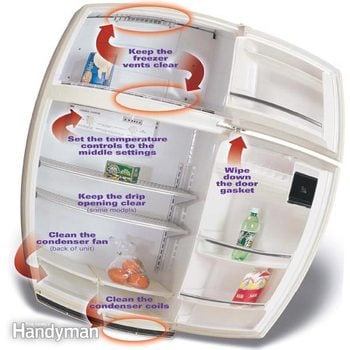
Spend 30 minutes on these unproblematic maintenance steps to keep your fridge running in tip elevation shape. It's hard to believe, only six unproblematic maintenance steps will foreclose almost 100 percentage of refrigerator breakdowns and eliminate those service calls. Take these steps and you can forget most spoiled food, lost time waiting for repair people and shelling out $lxx an hour plus parts for the repair itself. In this story, nosotros'll evidence y'all how to keep your refrigerator humming and trouble-complimentary. And nosotros'll also tell you what to check if a problem does occur.
You might also like: TBD
- Time
- Complexity
- Cost
- An hour or less
- Beginner
- Free
Step one: Clean the fridge condenser coils (five minutes)
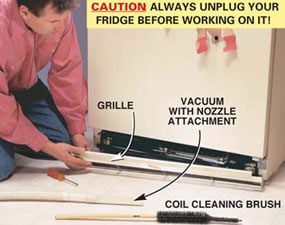
Photograph ane: Remove the grille
Unsnap the grille at the bottom of the refrigerator to admission the coils. If your coils are located on the dorsum, you'll have to roll the refrigerator out to get at them.
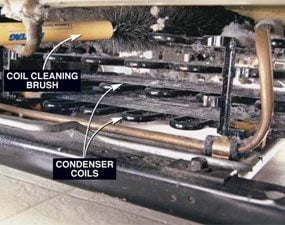
Photo 2: Castor off the coils
Clean the coils with a special refrigerator coil cleaning brush to loosen the clay and dust. Vacuum the coils as you brush. Be careful not to curve the fan blades. A gentle brushing will do the chore.
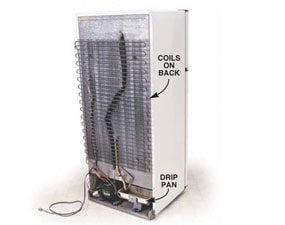
Cleaning Coils on the dorsum of the fridge
Some refrigerators take the coils on the dorsum of the unit. Brush and vacuum these coils in the same manner equally coils found under a fridge.
You can eliminate more than 70 percent of service calls with this simple cleaning step (Photos one and two). Skip this job and you'll be contributing to your apparatus repair technician's retirement fund. Not to mention handing over $5 to $10 a month extra to your utility company considering the fridge isn't running efficiently.
Practice it twice a year or more often if you have shedding pets. Their fur clogs upwardly the coils fast.
Condenser coils are located on the back of the fridge or across the bottom. These coils absurd and condense the refrigerant. When the coils are clogged with dirt and grit, they can't efficiently release estrus. The result is your compressor works harder and longer than it was designed to, using more energy and shortening the life of your refrigerator.
Make clean the coils with a roll cleaning castor and vacuum. A coil cleaning brush does a thorough job and will easily pay for itself. The refrigerator coil brush is bendable to fit in tight areas. They can be used for cleaning your dehumidifier and air conditioner coils likewise.
Circumspection:
E'er unplug your fridge before working on it!
Step 2: Clean the fridge condenser fan (5 minutes)
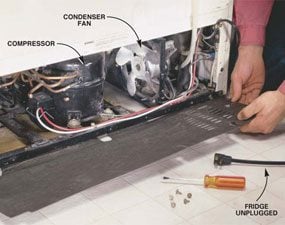
Photo one: Remove the lower back embrace
Access the condenser fan by rolling the fridge away from the wall and removing the lower back embrace with a screwdriver. Supersede the cover when you lot're finished. Information technology's essential for good air circulation.
Photo two: Brush and vacuum the fan
Clean the fan blades with the brush and vacuum so air can move freely across them. Besides clean the shaft past vacuuming the crease where the blade meets the motor. Don't lubricate the shaft; oil will attract dirt and crusade issues.
If the coils are located on the bottom of the fridge similar ours, make clean the condenser fan and the expanse around it. (Fridges with coils on the back don't take a fan.) The fan circulates air across the coils to assist cool them. At times, paper, dirt, dust and even mice can get sucked into the fan and bring it to a complete cease.
Photos i and two testify y'all how to clean the fan. Yours could be in a different area, just it's e'er next to the compressor. Most refrigerators will take a diagram on the dorsum or folded up under the front grille showing the location of the major parts. While yous're under there, wipe out the drip pan, a flat pan that collects h2o from the defrost cycle and allows information technology to evaporate.
Step 3: Wipe down the refrigerator door gasket (2 minutes)
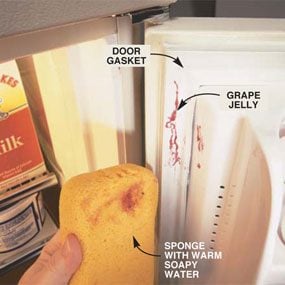
Make clean the door gasket
Wipe the door gasket regularly with warm water and a sponge. Don't apply detergent—information technology can damage the gasket.
Prevent an expensive gasket repair beak ($100 to $200) and cut downward air leaks by keeping your door gasket make clean. Syrup, jelly or whatever other sticky stuff dripping down the front sides of your refrigerator tin dry out and gum the gasket to the frame. The next fourth dimension you lot open up the door, your gasket tin can tear. Keep it clean and you'll get a prissy, tight seal, keeping the absurd air where information technology belongs, in the fridge.
To preclude wear, lubricate the door handle side of the gasket by sprinkling baby pulverization on a cloth and wiping information technology down one time a calendar month.
Three Types of Refrigerators
All refrigerators work on the same principle of cycling refrigerant through ii sets of coils. The evaporator coils do the cooling, and the condenser coils release accumulated heat. Where fridges primarily differ is in how they defrost.
A manual defrost is the oldest and simplest type. As the name implies, yous defrost these by turning them off and letting all the ice cook. The h2o so drips into a pan or runs into the refrigerator where you wipe it up.
Cycle defrost refrigerators have an evaporator plate in the refrigerator department that warms later each running cycle to eliminate frost buildup. But yous have to defrost the freezer manually past turning a punch to the defrost style. The water in nigh models flows into a channel in the back and so down through a tube to a drip tray under the refrigerator.
The frost-gratis refrigerator, the well-nigh mutual today, uses a heater to melt water ice on the evaporator coils. The heater is turned on past a timer and automatically shuts off. An evaporator fan distributes the cold air through the freezer. Many models accept an opening under the crisper drawers to draw water to the drip tray underneath.
Step four: Clear the freezer vents (five minutes)
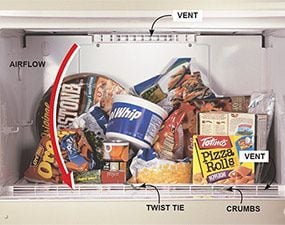
Keep the freezer vents unobstructed
Clear food packages away from the vent openings and make clean the air return and then crumbs and twist ties don't clog them.
These piffling vents on frost-free fridges let air to circulate in the freezer. Don't block them or permit crumbs or twist ties get sucked in around the evaporator fan or clog the drain tube. To help save energy, continue your freezer about three-quarters full to retain cold air. But don't pack it any fuller because the air needs to circulate.
Step 5: Set the refrigerator temperature controls to the middle settings (1 infinitesimal)
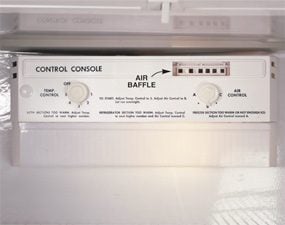
Adjust the temperature controls
Gear up the temperature controls to the centre settings. Make any adjustments according to a fridge thermometer. The optimum setting for your fridge is between 38 and 42 degrees F; the freezer, betwixt 0 and 10 degrees.
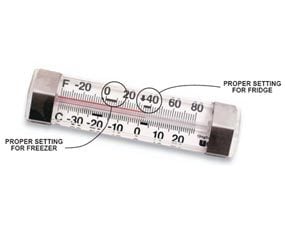
Temperature settings
Salve money by keeping your freezer fix at 0 F and your fridge fix at twoscore F.
This step won't necessarily prevent a repair, but it'll extend the life of your refrigerator by allowing it to run more efficiently, which reduces your electric bill. Your fridge has at least two temperature controls (except on manual defrost types, which take i). The one for the food compartment is a thermostat that turns the compressor on and off. The second, for the freezer, is just an air baffle. The bamboozle lets cold air from the freezer sink into the food compartment. Closing the baffle makes the freezer colder.
3 Ways to Go the Smell Out
- Charcoal briquettes blot the odor just like a filter in a range hood.
- Crumpled newspaper. The ink absorbs the odor.
- Baking soda is the old standby. Exit an open box in the fridge and replace information technology every three months for continuous deodorizing.
Stride six: Articulate and clean the drip openings (2 minutes)
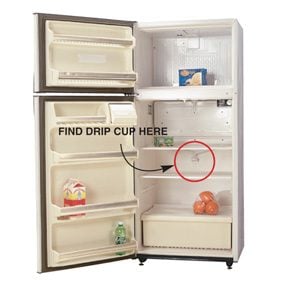
Locate the drip cup
Find the drip opening on your fridge
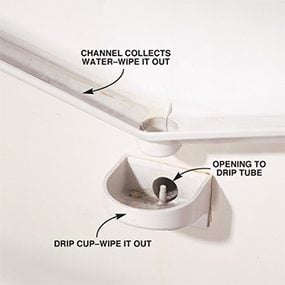
Close up of the baste tube opening
Locate the baste opening and wipe it out, being careful not to press whatever debris downward into the pigsty. Suck out crumbs with a vacuum.
Baste openings allow water that has melted from the defrost bike to menstruation down to a pan located past the compressor, where it evaporates. Check your possessor'south manual for the location on your fridge. On cycle-defrost fridges, a aqueduct directs the water to a tube in the nutrient compartment.
On frost-free refrigerators, look for a small cap under the crisper drawers that covers a hole, or an opening in the back of the freezer or fridge. If the bleed opening clogs, h2o will build up nether the crisper drawers and somewhen leak out onto the floor.
Troubleshooting
Service specialists will exist the kickoff to acknowledge: A ton of their callers don't require repair service at all. The solutions are and so easy they don't even require a toolbox. Before yous pick up the phone, check the post-obit listing. It merely might save you $seventy and a bit of embarrassment.
Got ability?
- Check the circuit breaker or fuse box to be certain power's coming to the outlet.
- Is the cord plugged in tight? Wiggle it around a little. A worn receptacle could let the plug fall out just enough for the connection to fail.
- Plug a light or any other electrical device into the outlet to encounter if information technology works. If it doesn't, y'all've got an electric problem, non a refrigerator problem.
- Check for a loose, worn or frayed power cord. Rodents often chew through a wire. Sometimes cords loosen when the refrigerator is moved.
What if you lot have power but poor cooling?
- Make sure the thermostat is turned on and set correct. On some models the punch is easily bumped, shutting the fridge down. Or kids could have messed with it.
Your fridge is running all the fourth dimension but the food'due south still warm.
- Vacuum the coils. Dirty coils can eventually crusade the overload protector on the compressor to shut the fridge downwards. It'll automatically come back on when the compressor cools, simply past then your food is commonly warm.
- Is the condenser fan jammed? (This applies only to fridges with the coils on the lesser.) Remove whatever obstacles and clean it thoroughly. Unplug the fridge and turn information technology a few times and see if information technology comes on. If it's withal non working, yous'll have to replace it.
- Is the light turning off when the door's closed? That piffling lite bulb can raise the temperature in the fridge substantially. To check information technology, shut the door and apply a butter knife to pull the gasket slightly away from the frame. If calorie-free shines out, the switch is bad or slightly out of alignment. Until you set up the switch, loosen the light bulb and then it goes out.
- Expect for ice buildup (frost-free fridges only) bulging on the within walls or the flooring of the freezer. Manually defrost the freezer by unplugging it. It'due south only a temporary fix, so call for service.
Required Tools for this Refrigerator Repair Project
Have the necessary tools for this DIY project lined upwardly before you kickoff—you'll save time and frustration.
Coil cleaning castor

Source: https://www.familyhandyman.com/project/how-to-avoid-refrigerator-repairs/
Posted by: dummerobeguistake.blogspot.com
0 Response to "How To Clean Condenser Coils On Whirlpool Side By Sides"
Post a Comment